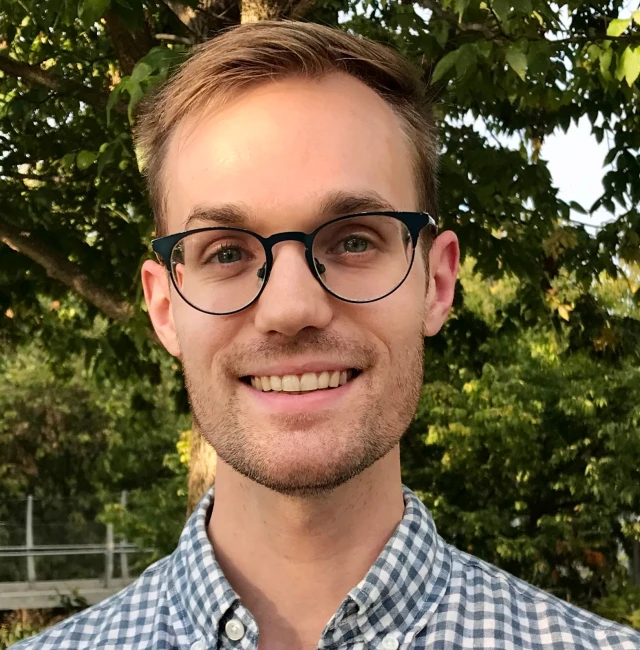
Can you and an AI ever really speak the same language? A Stanford scientist has the experiments.
Sharp model-building empiricist, fascinated by the improvisation of real conversation.
Robert Hawkins studies how people coordinate — how strangers with no shared vocabulary invent conventions and converge on a shared language through repeated interaction. He runs large-scale multiplayer experiments and builds models to match, and his PNAS work showed that the structure of an interaction constrains which conventions can form at all. Two people converge easily; six people is a different problem entirely.
His attention has turned to agents. When populations of language models talk to each other, conventions and collective biases emerge that nobody put there — and he is working on where that leaves us. Can humans and machines establish common ground, given that machines do not reason socially the way we do?
He'll be exploring emergence in agent systems and what finding common ground would actually require — with each other, and with the agents we are about to be surrounded by.
You'll take away: a precise account of something you deal with daily. Why teams talk past each other, why group size changes what can be agreed, and why your AI tools keep confidently misreading what you meant. He has the experiments, not just the intuition.
ONE LISTEN — "Language, Collaboration, and Social Reasoning", Stanford psychology podcast.
Summit 2026
Thursday ·
8:00pm – 9:00pm
Panel
The Couch (main auditorium)
Whether humans and machines can ever converge on shared meaning, taken up by researchers who study how conventions form between people, between species, and now between agents.
Saturday ·
3:15pm – 4:15pm
Fireside duo
Three researchers on convention, communication and constraint, and what coordination costs when some of the participants are machines.