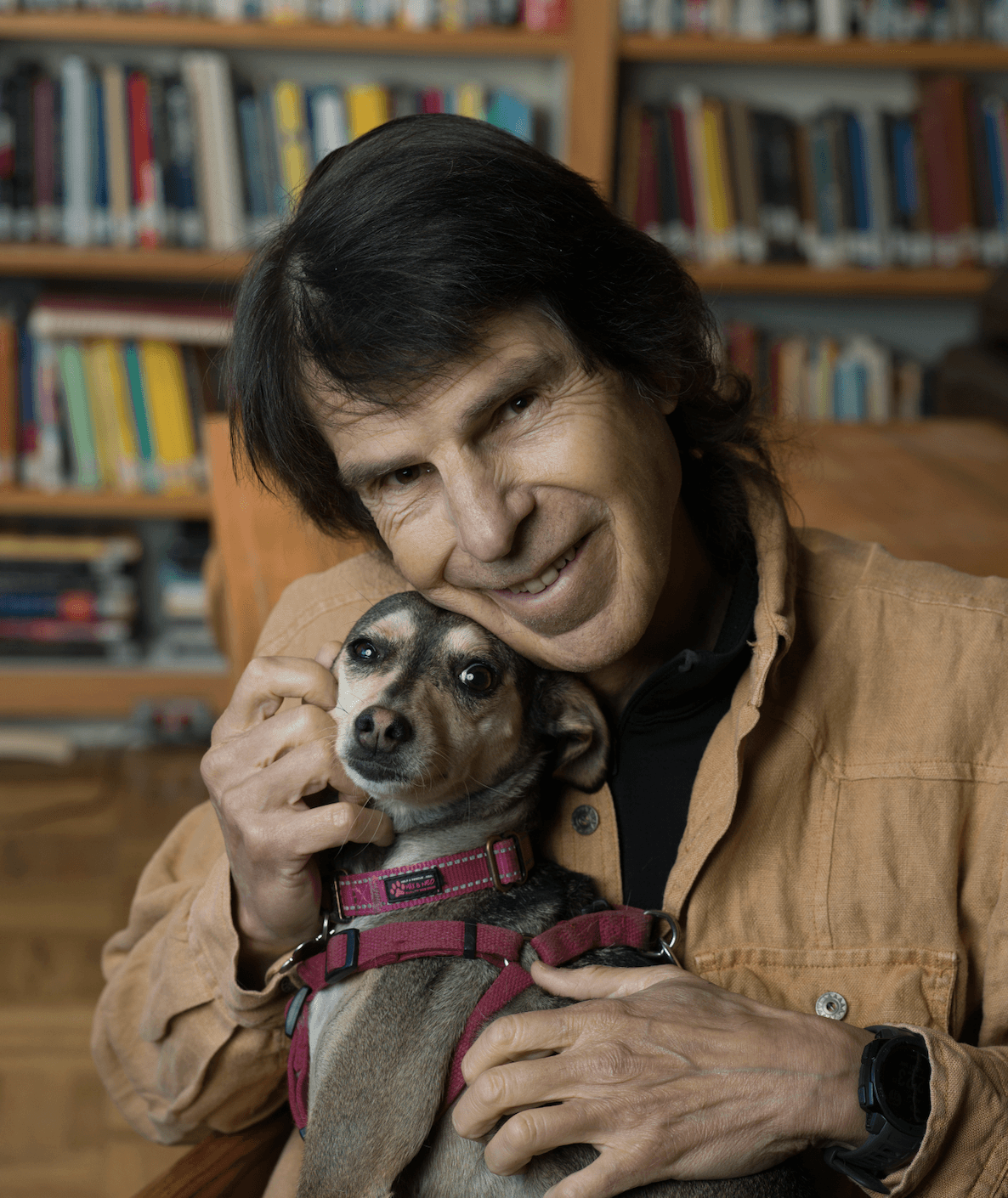
The man who mathematically proved that AGI's promised omniscience is impossible.
Foundational, rigorous, sweeping, a little provocative. The intellectual grounding of the Summit.
David Wolpert is a physicist and professor at the Santa Fe Institute. He is best known for the No Free Lunch theorems, which proved there is no universally best algorithm — every method that wins on one class of problems loses on another. In 2008 he went further, showing that no inference device inside a universe can fully predict, remember or observe that universe. It is a formal limit on knowing, and it applies to a scientist with a supercomputer exactly as it applies to a machine.
More recently he has been working on semantic information, where meaning emerges from an agent's drive to persist, and on what happens when many agents interact, communicate and co-evolve — the territory he calls a distributed singularity.
He opens Friday’s Unknowing because his mathematics is the Summit's baseline. The uncomfortable implication is not that AI will be hard to understand. It is that at a certain level of capability we will not be able to understand it, and no amount of effort closes that gap, because the limit is structural rather than technical.
You'll take away: a permanent upgrade to how you argue about AI. Once you can say why total predictability is impossible in principle, both the doom pitch and the omniscience pitch lose their grip, and you can make decisions without waiting for certainty that was never coming.
ONE WATCH OR LISTEN — "David Wolpert: The Thermodynamics of Meaning," Artificiality podcast. Our own conversation with him on the mathematics of meaning.
Summit 2026
Friday ·
9:00am – 10:00am
Keynote
The Couch
Alongside examining OpenAI's 10,000-agent Navier-Stokes proof and OpenClaw, David Wolpert shows why we can't predict what AI will become without assumptions that may be wrong, why AI can't predict what we'll become either.
Saturday ·
4:30 pm - 5:30 pm
Salon
Walk
Take a walk and ask the questions you didn't get time to before.