Making Sense of AI Use and Sentiment

Half of American adults now use AI chatbots. Two years ago it was a third. Over the same two years, positive sentiment in Glassdoor reviews mentioning AI fell from 58 percent to 43. This seems contradictory: how is it possible to have mass adoption of a technology people increasingly resent?
The reviews say it's about mandates, surveillance, layoffs, and work slop you now check because the person upstream didn't. These reasons are all real, but they are mostly outside any one worker's control.
We don't think these reasons are the whole story, because those same workers keep using AI—more of it, every month. In ten years of studying how people work with AI, one question keeps coming up: are you still thinking, or is the system gradually taking over the parts of your thinking that made you good at the work in the first place?
We call the thing that matters here authorship: whether you are consciously directing what AI does to your thinking, rather than simply accepting what it gives you. But authorship is difficult to measure directly. So we started looking at the other side of the equation: the work itself.
Back in 2016, we analyzed more than 900 occupations and found that unpredictability was one of the things that protected work from automation. That held for years. Then generative AI started handling increasingly unpredictable situations on its own, and that forced us to rethink what we had been measuring.
Unpredictability was a symptom. The more interesting property was irreducibility: whether a job can be pulled apart into discrete tasks, solved piece by piece, and reassembled without losing something essential—or whether pulling the work apart actually changes the work.
We built IRX, an index that scores work across five forms of resistance to being broken into pieces: being physically and socially situated, making contested judgments, combining knowledge across domains, dealing with genuine novelty, and exercising aesthetic judgment.

This gives us a much more useful way to think about AI and your job. Instead of asking whether AI can do your tasks, you can ask which parts of your work become more valuable when AI can do the separable parts, and which parts you need to keep developing yourself, with and without AI.
And that brings us back to the anxiety about whether you are still able to think. The point of understanding the structure of your work is that you can deliberately put AI in places where it expands your capability while keeping yourself in the parts where your understanding, judgment and authorship have to grow.
That is where the economics of AI gets interesting. The goal isn’t simply to get more work out of the machine but to use AI in a way that makes you better at the work.
Most jobs, including most knowledge jobs, stand on one or two spokes. That concentration is the vulnerability. Put four jobs side by side and something uncomfortable shows up: the parts AI is getting very good at are often the very parts a job is built around.
But the same technology creates a very different opportunity in work with a higher and more distributed IRX. There, AI can take apart some of the work without taking apart the whole job. It can give you more room to do the parts that require you to be there, make the call, connect the fields, figure out what is going on, or decide what good looks like.
That changes the question from “Can AI do my job?” to “Where can AI take work off my plate while leaving me more of the work that makes me better at my job?” and “how can I use AI to extend what I can irreducibly do?”

Software developers got hit first and fastest, and I don't think that was about intelligence. So much of the work was pattern recognition, which turned out to be the most learnable thing we do.
Accountants are next in line but someone still attests and answers for the numbers, and whether that's a real job or a rubber stamp depends entirely on how firms redesign the work.
Lawyers split down the middle. Drafting and research are going quickly. But somebody has to actually argue—in front of a judge, a client, the other side—and machines have no standing there.
Architects have the highest irreducibility. A person on site. Contested decisions with a client's money and a city's codes. Knowledge braided across engineering, aesthetics, regulation.
Broadening is the opportunity and you can use AI to do just that. It reshapes what you notice, how you think, and who you're becoming as you use it. The directing is a practice, and it's learnable. Here I want to show you what directed looks like.
One of the people in our research is a process engineer in field science. His AI use is about as deep as we've seen, and his whole way of thinking has changed. He directed the change, and the way he did it is actually quite simple.
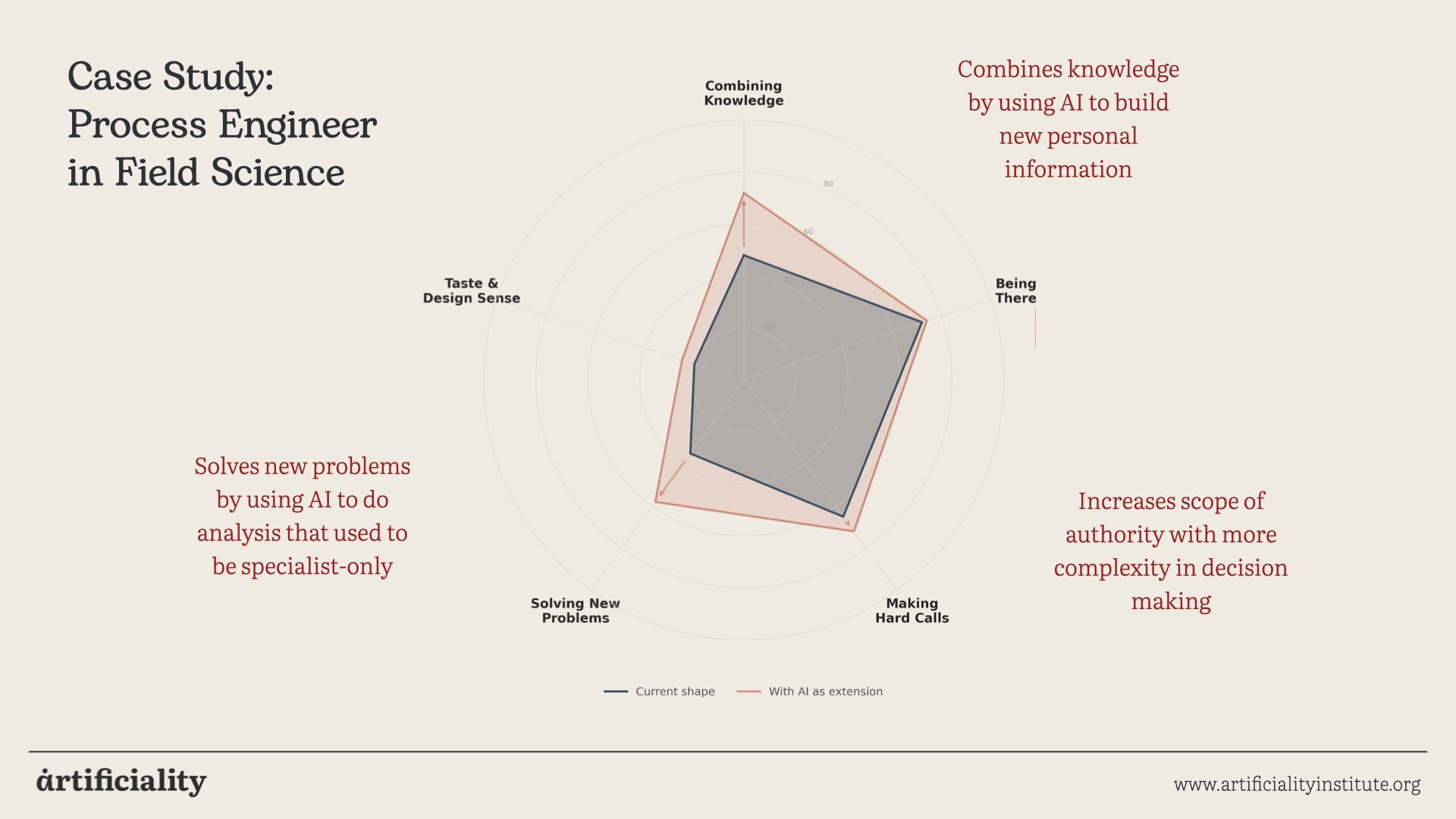
He started by vibe coding a dashboard. Not a company system—a personal one, just for him, braiding field data, manufacturing plant data, equipment histories, and the specialist literature into a single view that means something to him and nobody else. He described what he wanted, argued with what came back, and kept the parts that matched how he actually thinks. That's the combining-knowledge spoke: he now holds information no one else holds, because he built the tool that gathers it.
The dashboard opened adjacent doors. Analysis that used to be specialist-only he now runs himself and now spends more time with his supervisor to make sure he's still learning. All of this put him in front of problems nobody had posed to him before. That's the novelty spoke growing. And the compounding part: when you're the one holding unique information and solving problems no one else can, the hard decisions start coming to you. His scope of authority grew—more complexity in his decisions, more of the contested ground.
So that's what we bring to teams. An hour, remote, live—how your people grow past the old edge while staying the authors. Then questions, the ones we are asked the most:
How do we grow expertise when AI does the junior work?
What do we do about errors nobody catches until they compound?
How do teams think together when everyone is thinking with a machine?
What would adoption look like if it grew our people, and showed up in how they feel about it?
We answer these live in the Stay Human Briefing. Your team, your questions.
Click here to see more on the briefing as well as our keynotes and workshops.

