IRX: The Irreducible Complexity Index
On June 2 2026 the Institute published its most substantial research release of the year: the Irreducible Complexity Index (IRX), a decade-in-the-making rethinking of what AI does to human work.
The story starts in 2016, when Helen and Dave first analyzed the ONET database of 894 US occupations and found that the work most resistant to automation was the work full of unpredictability—messy people, unknown environments, situations that change while you're in them. That finding held for a decade. Then generative AI started handling unpredictable situations on its own, and it became clear that unpredictability was a symptom, not the cause. The real cause is irreducibility: some work can be pulled apart into pieces, solved piece by piece, and reassembled. Some cannot—because each part is conditioned by all the others at once, and pulling them apart makes the thing you were doing stop existing. That is the actual line between what AI absorbs and what stays human.
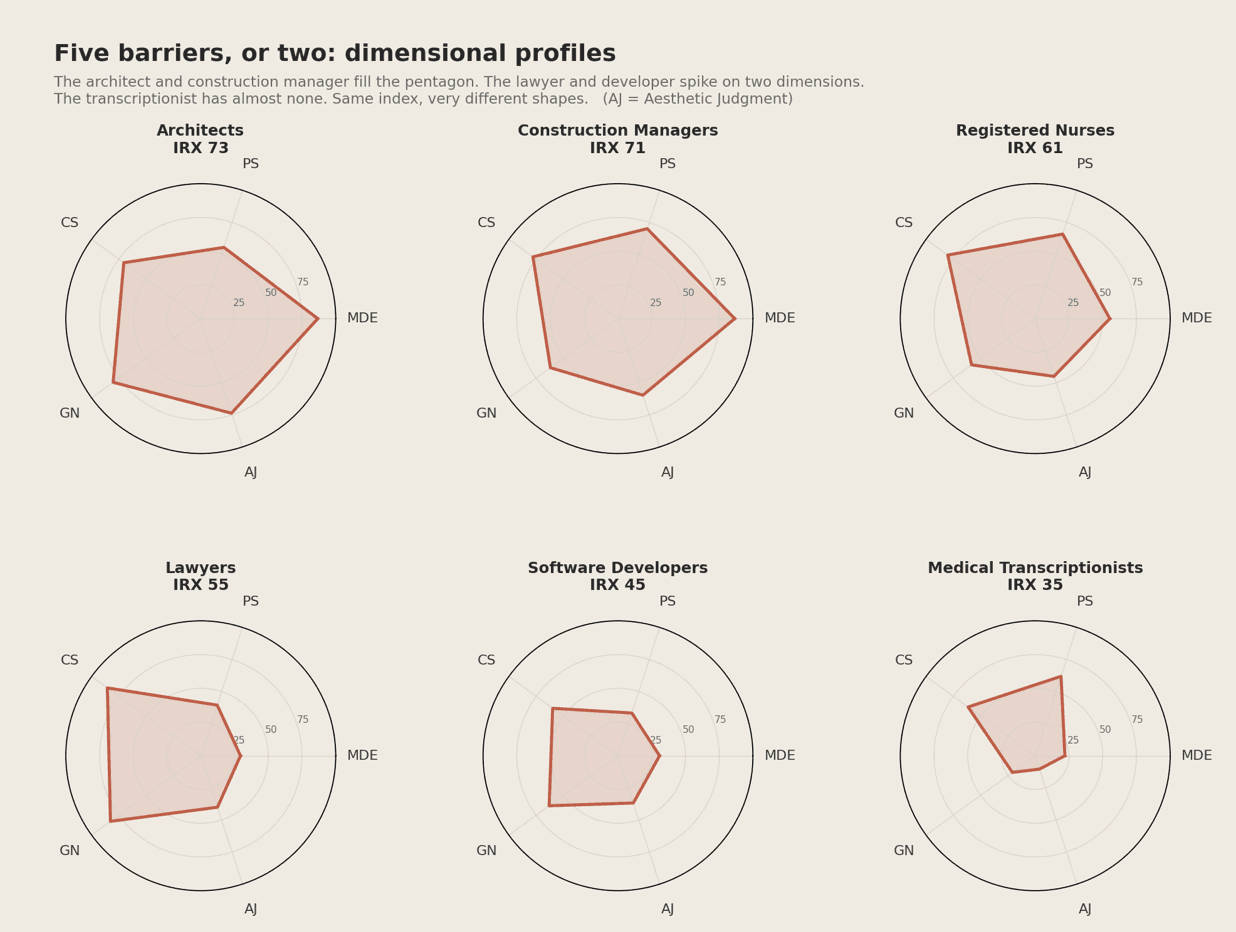
The IRX scores all 894 occupations across five distinct kinds of resistance: whether the work needs a body in a place, whether someone must own a contested call, how many knowledge domains it braids together at once, whether it requires solving problems nobody has posed yet, and whether it demands a sense of taste no rubric can capture. Progress on any one does nothing to resolve the others. The most resilient occupations combine several at once—and most work, including most knowledge work, relies on only one or two. That concentration is the vulnerability; broadening it is the opportunity.
One finding inverts conventional career advice: when AI's current capability is placed on the same scale as human skill requirements, the skills we're told to chase—programming, mathematics, analysis—are where AI is furthest ahead, while interpersonal and physical skills are where humans lead widest. What we used to call soft skills we should perhaps now call higher skills.
The research also pushes back on the replacement story. In years of fieldwork, what we keep finding is people doing more, not less: the routine layer gets absorbed and the harder work underneath surfaces. Developers become builders; analysts start making the calls their data was meant to inform. The circle of what work asks of people doesn't shrink—it expands. That's what we call authorship, and it points to what AI should actually be for: not efficiency or replacement, but extension and expansion. Minds for our minds at work.
Unusually for this field, the IRX makes testable predictions—including one that would falsify it: if AI begins performing whole occupations scoring above 70, not pieces but the entire integrated practice, the framework is wrong. We'll be validating it against employment and displacement data as it accumulates.
The full research is available to subscribers—free, and kept behind a registration wall for human eyes only, not machine crawlers.

