Oregon Community College Association Keynote
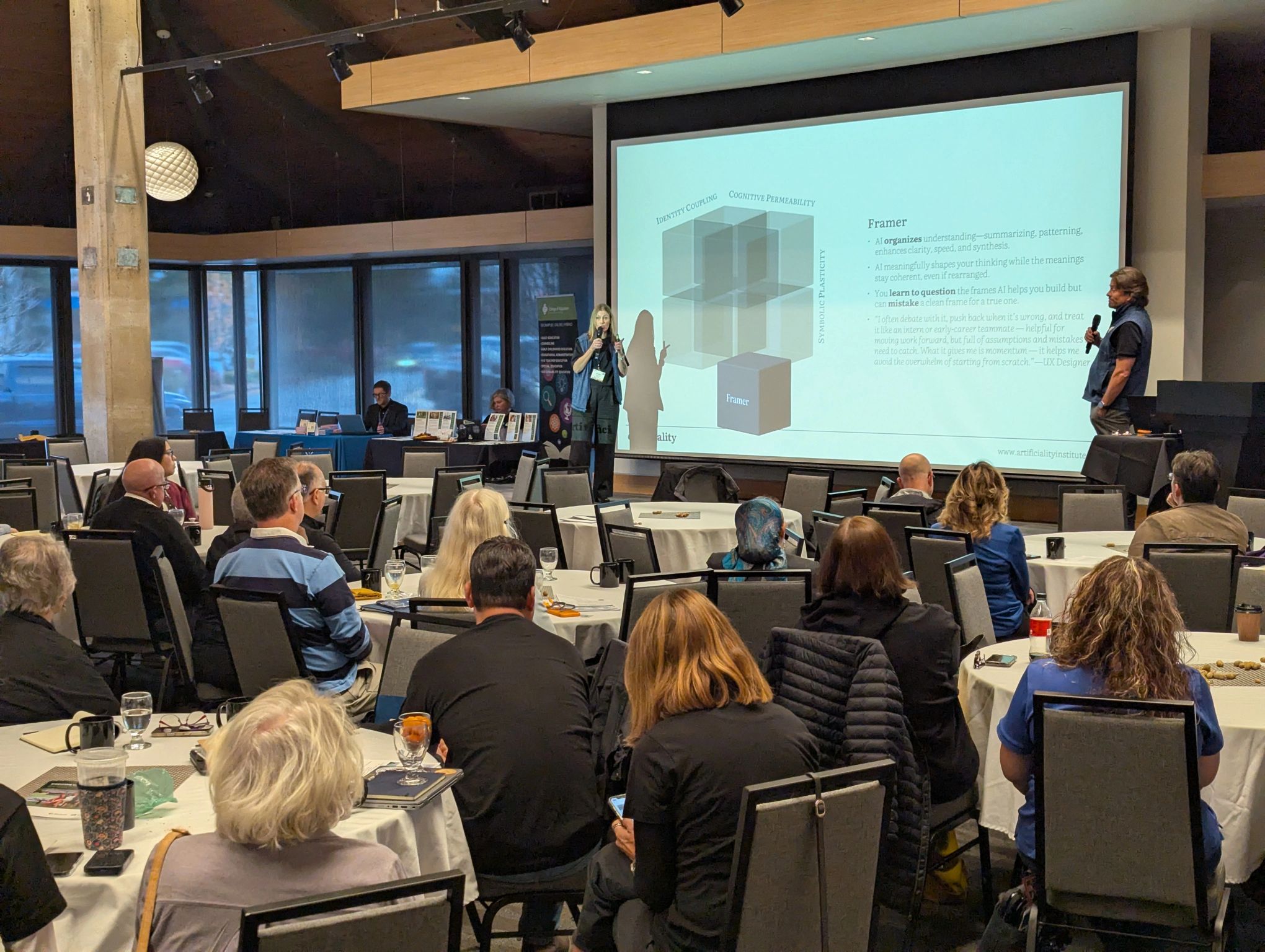
We delivered the keynote address at the Oregon Community College Association's annual conference in Hood River, speaking to board members, presidents, and administrators from Oregon's seventeen community colleges.
We opened by asking the room to share their own "moment of recognition" with AI—that first time it did something unexpected. A grants director described using AI to review proposals against RFPs. Someone else recalled an early ChatGPT experiment with a movie script, astonished when the system remembered a detail from two paragraphs earlier and wove it back in. These moments, we explained, are the first of five stages people move through as they adapt to AI—from recognition to calibration to a blurring state where thinking and AI interaction become hard to separate.
Then we posed a harder question: Is there any part of your work you didn't want to show to AI, because if it did well, you'd have to rethink what makes you good at it?
The room got quiet.
The Q&A surfaced the question at the heart of higher education's AI reckoning: what is the role of community colleges in providing truth? If AI systems are probabilistic—finding patterns in vast combinatorial spaces rather than retrieving facts—how do institutions built around truth-seeking adapt?
Our answer was unsettling but honest: we don't fully know yet. These systems will likely remain uninterpretable, and may get weirder and more alien over time. The path forward probably isn't humans sitting in judgment—right, wrong, true, false—over AI outputs. It's humans and AI working in conjunction, bringing different kinds of uncertainty to the table.
We offered one reframe: if the last 500 years of human progress has been about finding certainty, and we've now created systems that may be better at prediction than we are, then what's left for us might be unpredictability. Sitting with uncertainty. Approaching the world with unknowing. That's not a deficit—it may be our superpower. And teaching people to embrace that uncertainty, rather than flee from it, might be one of the most important things community colleges can do.

