Helen Edwards' The Artificiality Is Now Available
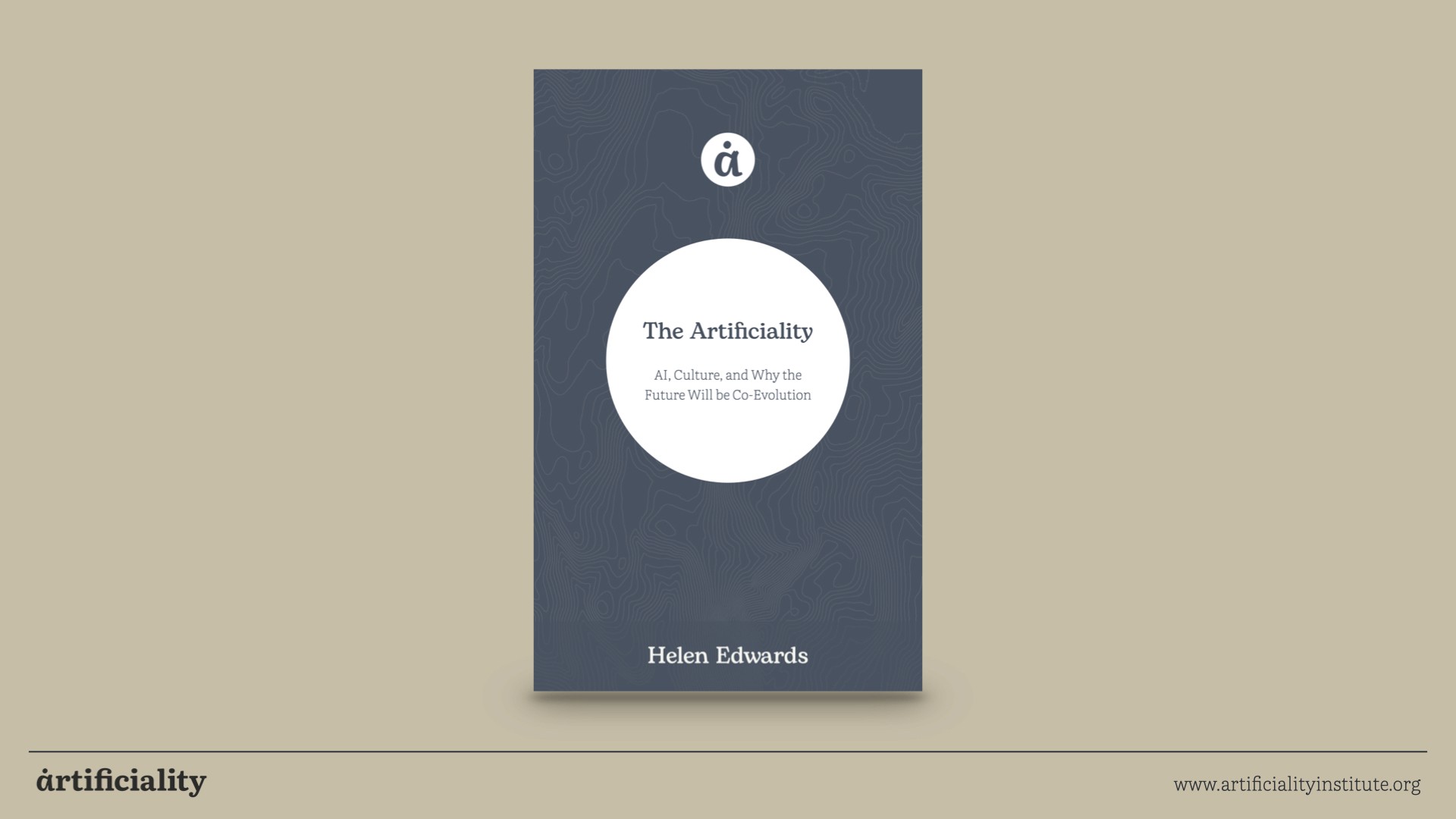
The Artificiality Institute is pleased to announce the publication of Helen Edwards' new book, The Artificiality: AI, Culture, and Why the Future Will Be Co-Evolution.
The book is available now as a digital edition, with physical copies coming soon.
What the Book Is About
Most conversations about AI focus on capabilities—what these systems can do, what they might do next, whether they'll take our jobs or save the world. Helen's book asks a different question: What's happening to us?
Co-evolution between humans and AI is already underway. Culture now drives human adaptation faster than genes. AI has entered that process as a participant. Your choices about how you use these systems are evolutionary forces, whether you notice or not.
The book traces this argument through eleven chapters, moving from the dissolution of old categories (biological here, computational there) to the practical question of what we want to preserve as everything changes. Along the way, it draws on evolutionary biology, cognitive science, and philosophy of mind—weaving conceptual argument with personal observation.
It begins in a lab at Tufts University, where the boundary between biology and computation has already dissolved. It ends with a design philosophy for a future where synthetic intelligence is integrated into our lives, potentially changing humanity forever.
Core Arguments
Helen makes several claims that run counter to the dominant AI narratives:
The paradigm is shifting—but not toward silicon rapture. The transhumanists want to upload consciousness to machines. The boosters claim consciousness is substrate-independent. The more you learn about what biology actually does, the less plausible those ideas become. What's emerging instead is a deeper appreciation of what living systems are and why they're different.
Culture now drives human adaptation faster than genes. AI is the fastest cultural technology we've built. The choices we make about it become evolutionary forces.
AI learned something real from biological data—but it's missing something important. AI systems absorbed patterns shaped by four billion years of evolution. But they learned by observation, not participation. They internalized the shape of biological intelligence without inheriting the conditions that made the shape necessary.
Mortality isn't a bug to be fixed. Finitude—the fact that life ends—is the condition under which human meaning takes shape. Understanding this changes what co-evolution can and should look like.
We've always been absorbed into larger wholes. Corporations, cities, languages—humans have long been components of systems larger than ourselves. AI accelerates this and makes it cognitive. The question is whether we can stay human inside that process.
Read It Now
The complete digital book is available here: The Artificiality: AI, Culture, and Why the Future Will Be Co-Evolution
Physical copies will be available soon.

