Becoming Synthetic: Keynote at the Autonomous Summit
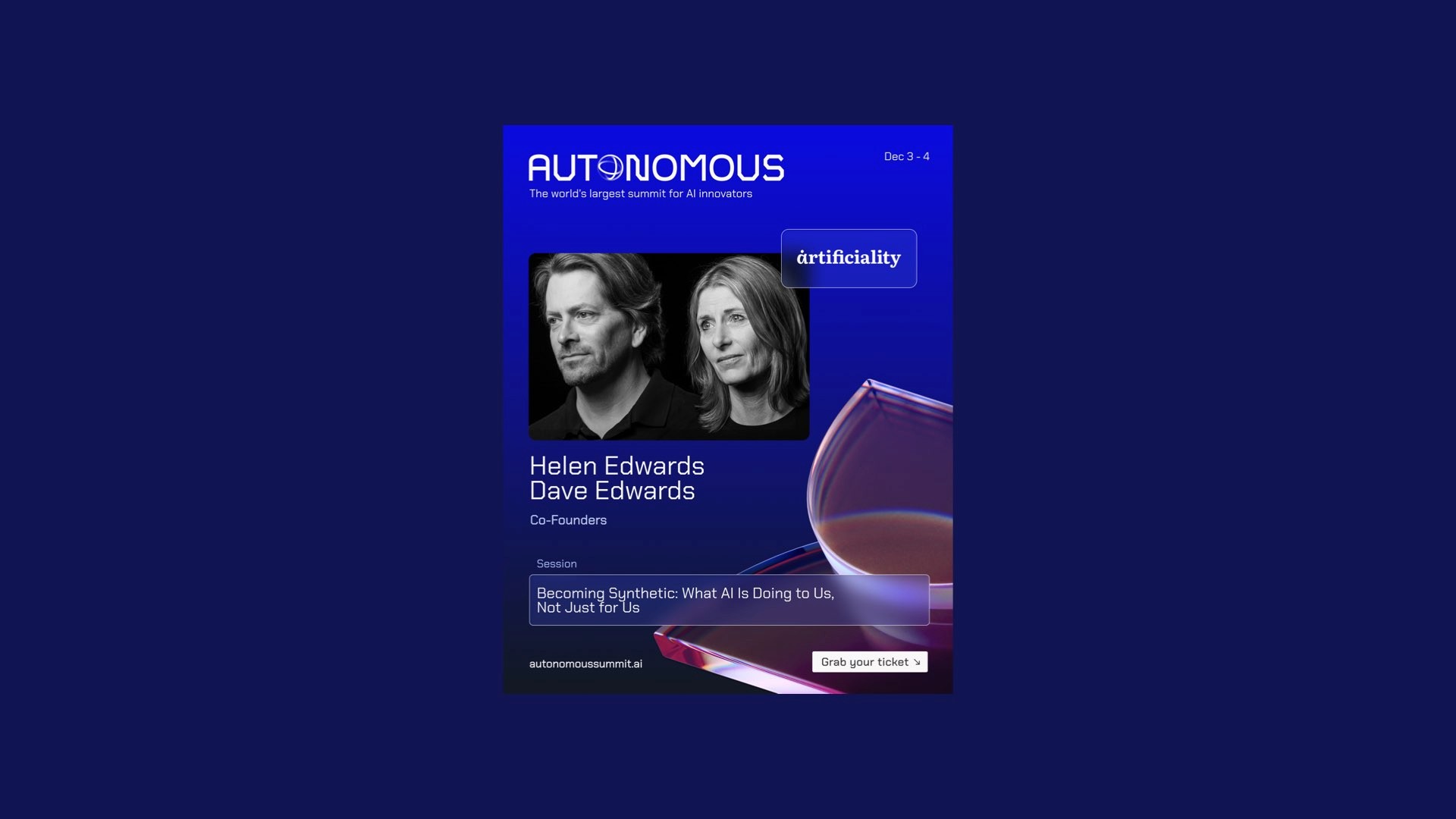
We delivered a virtual keynote at the Autonomous Summit—one of the world's largest gatherings for AI innovators—titled "Becoming Synthetic: What AI Is Doing To Us, Not Just For Us."
The talk opened with what we're hearing from people in our research: AI feels different from other tools. People describe a blending of thoughts, shared authorship, even emotional connection. We're either watching an old human pattern of adaptation at new speed and depth—or we're witnessing the early stages of genuine human-AI symbiosis. Maybe both.
We walked through the AI Adaptation Cube—a framework mapping how AI changes our thinking, our being, and our becoming—and introduced two of the eight roles people assign to AI: the Framer (organizing your understanding, but making it easy to mistake a clean frame for a true one) and the Creator (where authorship feels genuinely shared and originality becomes collective).
The deeper question: what does it mean to be human when an entire species is entangled with artificial minds we've built but don't fully understand? The Enlightenment told us we were the ones who reason, who find truth, who make meaning. That story is shifting.
We see two common responses—worship (follow the superintelligence) or fortress (build walls, shut AI out). Neither works. Worship erases who we are. Fortress pretends there's nothing to gain.
So we proposed a different path: unDesign. Not the absence of design, not anti-design—design oriented differently. The history of design has been about reducing uncertainty, making things legible. unDesign inverts this. The unknown, the unpredictable, the unplanned—these aren't bugs. They're the medium where genuine encounter happens. We don't design outcomes; we design the space where outcomes can emerge.
We used artist Thomas Saraceno's hybrid webs as a metaphor: he creates conditions for different spider species to build collaboratively, producing structures no single species could make alone. As his collaborator puts it: "Emergent dynamics can destroy the existing order, but they can also figure into collective hopes."
That's the invitation. Not control, not surrender—but designing the conditions where something new between humans and AI can take shape.
Watch our talk here.

