Artificiality Book Awards 2024
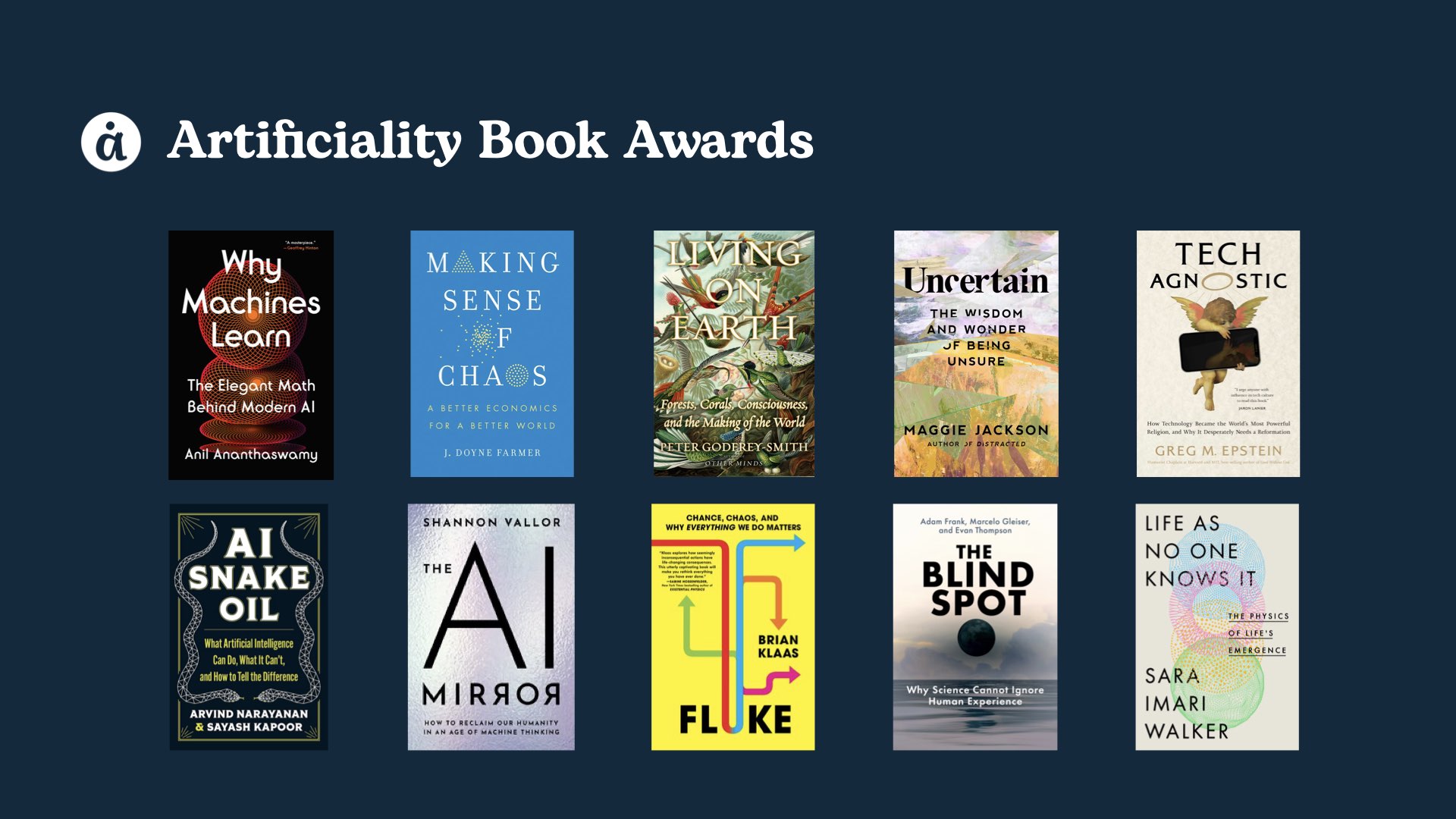
We announced our inaugural book awards—ten titles that shaped our thinking over the past year about the intersection of complexity science, emerging theories of reality, biology and evolution, AI, consciousness, and the social sciences.
The selections fall into three categories: books that tackle The Artificiality head-on (challenging our most fundamental assumptions about reality, complexity, and agency), books that have powerfully shaped understanding of AI and its implications for human thought, and exemplary works of popular science that blend scholarly rigor with engaging narrative.
The winners:
Life As No One Knows It by Sara Imari Walker—our top pick. Sara's work moves beyond assembly theory to unpack frontier ideas on the relationship between matter and consciousness, arguing that consciousness organizes matter over time. Essential reading for understanding how concepts of life and intelligence might extend into artificial systems.
The Blind Spot by Adam Frank, Marcelo Gleiser, and Evan Thompson—a challenge to science's foundational assumption that objectivity means removing the observer. They argue this move left us unable to address some of the biggest problems in physics, biology, and consciousness research.
The AI Mirror by Shannon Vallor—our top AI-centric read. Shannon uses the mirror metaphor to show how AI reflects human cognition in all its complexity, limitations, and distortions. The best book of its kind in 2024.
Tech Agnostic by Greg M. Epstein—a vivid examination of how the tech industry has created a religion, complete with AI gods and tech-driven rapture fantasies. The year's best call to action.
AI Snake Oil by Arvind Narayanan and Sayash Kapoor—sharp, precise clarity cutting through the AI industry's biggest myths. Buy it for the chapter on why AI can't fix social media alone.
Why Machines Learn by Anil Ananthaswamy—the ultimate explainer for anyone who's ever wondered how AI actually works, wrapping equations in stories that make the math feel alive.
Uncertain by Maggie Jackson—a deep exploration of why uncertainty isn't something to tolerate but something to embrace. Personal to us: reconceptualizing uncertainty is one of our soapbox issues.
Fluke by Brian Klaas—a powerful argument for complexity thinking, including the concept of "critical slowing down" as systems approach tipping points.
Making Sense of Chaos by J. Doyne Farmer—a challenge to the oversimplified assumptions of traditional economics using complexity science tools.
Living on Earth by Peter Godfrey-Smith—a meditation on connection to the natural world, with subtle but vital questions about what it means for intelligence to emerge in synthetic systems.
Read about all the winners here.

